Can AI Help Farmers Grow More? Inside Rewaza Farms with Vincent Odero
Noelyne Sumba · · 6 min read
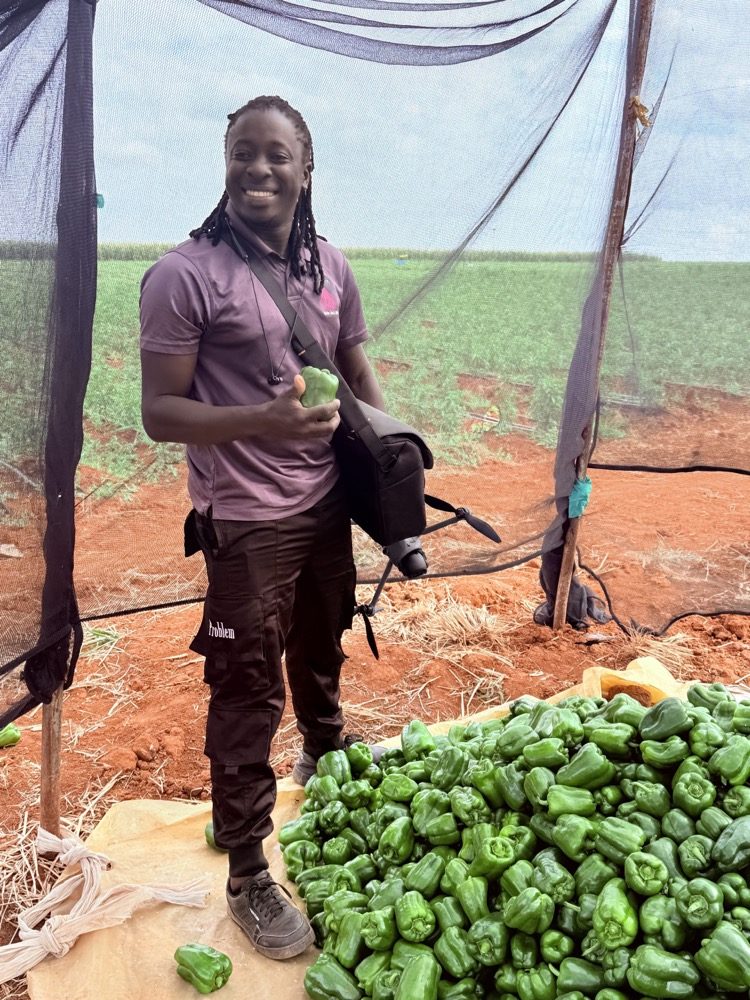
Ask Vincent Odero what it takes to grow food and he doesn't start with seeds, sprays or machines.
"To grow food, first and foremost it takes passion and discipline and the love of farming."
Vincent is the founder of Rewaza Farms in Machakos, Kenya. The farm started in 2022 as a pilot growing basil for export. Today it grows herbs and chilies, including bird's eye chili, and handles everything from cultivation to packaging and global distribution. Its motto says a lot about how Vincent thinks about food: "Treat your food like your medicine."
We spent a morning walking the farm with him to see what a working day looks like, where the hard decisions come from, and whether AI can really help a Kenyan farmer.
A day on the farm starts with walking it
Vincent commutes from Nairobi and gets to the farm at around 10am. The first job isn't spraying or harvesting. It's walking. He calls it the cultural method of pest and disease control: patrolling and scouting the field with your own eyes.
How often? Many farmers think once a week, or twice a month, is enough. Vincent disagrees:
"That's actually too little. Twice in a week minimum. That's a bare minimum."
Each visit, you look for changes: a disease starting, a pest ravaging a section, anything you can stop before it spreads.
The farm is laid out so the walk has a flow. He goes through the younger blocks first, then the older ones, ending at the blocks closest to harvest. On the day we visited, that was a block of onions at the curing stage, when the neck goes soft and bends over. Those onions were ready for market.
The last stop is the pump house down by the river, to check the machine is running properly. Water is the one thing a farm can't do without.
Spotting problems early saves money
Vincent showed us a leaf marked with purple blotch, a fungal disease that spreads through the air and through contact. With workers moving between blocks, diseases and pests travel easily. That's why he says every farm needs someone who knows how to identify them, whether that's the owner, a farm manager or, on bigger farms, a dedicated scout who walks the field early each morning and writes a report.
That report makes spot spraying possible. Instead of spraying the whole farm because one corner has thrips, you treat only the problem area.
"Let me just spray in this area instead of using money to do a blanket spray across the whole field."
It's a simple habit, and it cuts costs.
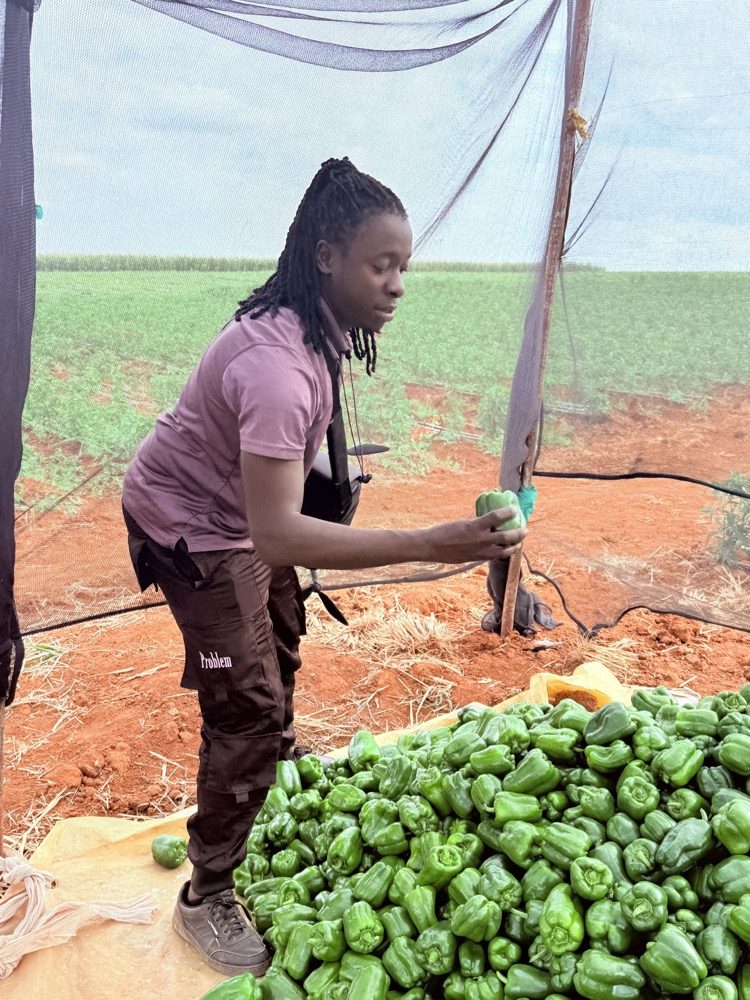 Checking the harvest at Rewaza Farms, Machakos.
The rain changes everything
Timing came up again and again. Vincent plans his onion harvest so the bulbs are out of the ground before the rains arrive. When we visited, he expected rain within about a week.
The rains also shift the economics of other crops. Tomatoes and capsicum don't do well in wet weather, so farmers who keep them going through the rains need a lot more fungicide, and that pushes up the cost of production.
"When it's dry, pests love dry areas. But when it's wet, controlling diseases, it takes a lot. And it needs expertise."
So a farmer looking at tomato or capsicum prices in the rainy season has to weigh two things: the market price, and what it will cost to protect the crop long enough to sell it. Markets matter too. Vincent knows that if he takes produce to Makongeni, Githurai, Marikiti or Muthurwa, he'll find a buyer. The hard part is knowing what to plant, and when, so the harvest lands at the right price.
How Vincent already uses AI on the farm
AI wasn't popular when Vincent started farming. But over the past two years he has started using his phone in the field. When he sees something on a plant he doesn't recognise, he takes a close photo and uses an image search tool to get suggestions.
"It gives me a rough idea of this could be this, this, this or this."
He has also tried a plant-diagnosis app. His verdict: these tools are useful for narrowing down what the problem might be. What they often can't do well is tell him exactly how to deal with it.
We asked whether he'd trust an AI tool that wasn't built with African farmers in mind. His answer was practical:
"As long as it enables me to get better results from whatever I am doing, I would definitely work with it and be interested to learn more about it."
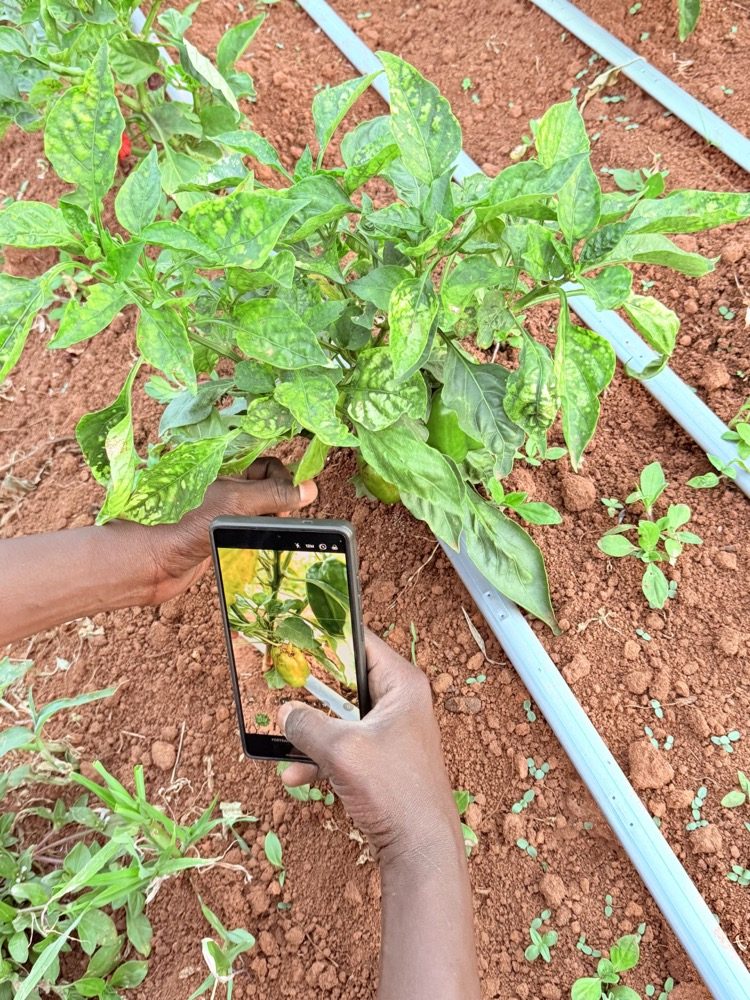 A close, clear photo is the starting point for a crop health check.
The one thing he wishes AI could do
We asked Vincent what he'd want from AI if he could pick one thing. He didn't hesitate: the market.
"I should also be able to project and say: in the next four months, from my calculations, the diesel price has gone up because of chemical fertilisers going up. So I predict that in the next four months, onions will go at 80 shillings."
He wants to look ahead before committing a block to a crop.
Nobody can promise an exact future price, and anyone who does is guessing. But a farmer can make better decisions with dated price records, an understanding of seasonal gluts and scarcity, and a clear view of their own costs.
What Ark Node AI's farmer tools can do
This is the gap we built the Ark Node AI Farmers section for. It works on any phone, with no app or account needed, and you pay per task with M-Pesa or Bitcoin Lightning.
- Crop health photo check. Take a clear photo of the affected leaf or plant, describe what you're seeing, and get possible causes, low-risk next checks and when to involve an extension officer or plant clinic.
- Planting seasons. Work out when to plant in your area, how long the crop takes, and how to stagger planting.
- Fertiliser guidance. Basal and top dressing for your crop and stage.
- Pest and disease control. Including fungal diseases like the ones Vincent battles in the rains, with guidance on active ingredients and safe use.
- Market prices. Look up dated prices from named markets for 10 sats, charged only when price records are actually returned. No invented "today's price".
- Price outlook. An estimate of likely price windows built from dated records and seasonal patterns, always given as a range with the reasons behind it, to help you time planting and selling. Always confirm with current buyer offers before you decide.
Most farmer AI tools cost 60 sats. It's a decision aid, not a crystal ball: the scouting, the timing and the judgement are still yours.
Lessons from Rewaza Farms
- Scout at least twice a week. Walk young blocks first, then older ones.
- Know your pests and diseases, or have someone on the farm who does.
- Spot spray where the problem is, not across the whole field.
- Plan around the rains, both for harvest timing and for the extra cost of disease control.
- Look at the market before you plant, not just when you harvest.
Watch the full visit
Video coming soon. We filmed our visit to Rewaza Farms, and the full video will be on our YouTube channel shortly. We'll link it here.
Rewaza Farms shares its journey on Instagram, TikTok, Facebook, YouTube and LinkedIn under Rewaza Farms, and you can find them at rewazafarms.com. Vincent told us they're glad to reach "genuine farmers who have boots on the ground", and some of them visit the farm to see it for themselves.
Thank you, Vincent, for having us.
Ark Node AI gives everyone access to powerful AI on any phone, paid per task with M-Pesa or Bitcoin Lightning. No subscription, no card. Because intelligence shouldn't belong to the few.
Ready to try it?
No app, no signup, no subscription. Pay per task with M-Pesa or Bitcoin Lightning.
Try the farmer tools →